
Bond & Money Market Mastery
Lesson 2: Government vs. Corporate Bonds 🏛️🏢

Understand the Differences with Real-Life Examples 🔍
In this lesson, you’ll discover the key differences between government bonds and corporate bonds. Knowing how they work will help you choose the right bond based on your financial goals, risk level, and income expectations. Let’s make it simple with real-life examples! 🚀
What are government bonds? 🏛️
Government bonds are issued by national or local governments when they need money to fund public projects like roads, hospitals, or schools 🏫.
When you buy a government bond, you're lending money to the government in exchange for:
✅ Regular interest payments (called the coupon 💰). ✅ Your full investment back on the maturity date 📅.
Real-life example:
Imagine your government wants to build a new high-speed train 🚄. To pay for it, they issue bonds. You buy one, and every year you receive interest payments until the bond ends and you get your money back.
Why choose government bonds?
- ✅ Safer investment (low risk).
- ✅ Backed by the government.
- ✅ Reliable, steady income.
⚠️ Downside: Lower returns compared to riskier investments.
What are corporate bonds? 🏢
Corporate bonds are issued by companies that want to raise money to grow, develop new products, or expand globally 🌍.
When you buy a corporate bond, you're lending money to a business, and they promise to:
✅ Pay you higher interest than government bonds. ✅ Return your full investment on the maturity date.
Real-life example:
A car company wants to create a new electric vehicle 🚗⚡. To fund the project, they issue bonds. You buy one and receive larger interest payments than a government bond, but there's a higher risk if the company runs into financial trouble.
Why choose corporate bonds?
- ✅ Higher interest payments.
- ✅ Opportunity for better returns.
⚠️ Downside: More risk. If the company faces problems, they might not be able to pay you back.
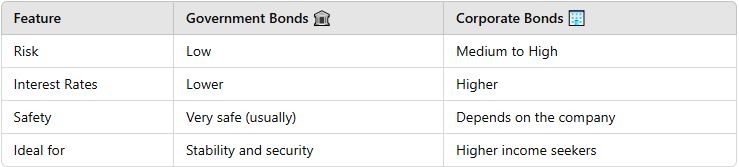
Quick comparison table ✅
What are credit ratings? ⭐
Credit ratings help you measure the risk of a bond.
- AAA = Super safe. 🟢
- BB or lower = Riskier. 🔴
Before buying corporate bonds, check their credit rating. It's like a financial health check-up 🏥 for the company.
Quick recap ✅
- Government bonds = lower risk, lower return, high safety.
- Corporate bonds = higher risk, higher return, depends on the company's strength.
- Credit ratings help you evaluate the safety of a bond.
Now you’re ready to understand which type of bond fits your strategy! Next, we’ll explore other types of bonds like fixed coupon and floating rate bonds.
Let me know in the comments if you're enjoying these lessons! 💬👇
⚠️ Risk Warning
This content is for educational purposes only 📚 and does not constitute financial advice. Neither the author nor this page is responsible for any decisions made based on this material.
Copy Trading does not amount to investment advice. The value of your investments can go up or down 📉📈. Your capital is at risk. Always do your own research before making any investment, and if you're unsure, consult an independent financial expert.
Investing in ETFs or any securities involves market risks, including the potential loss of your capital. Make sure you do thorough research and seek advice from a qualified financial professional before taking any investment decisions.
🔗 Ready to Get Started?
Demo account — explore concepts 🔍
Check out my profile and stats: ➡️ View my eToro profile



About the author
André Cruz — Popular Investor on eToro, managing a disciplined, risk-controlled long-term portfolio. Personal performance exceeds 800% since 26 March 2019, with CISI Level 3 and Level 4 qualifications in Wealth & Investment Management.
Follow me on eToroKnowledge check
5 questions. You need 70% to pass this lesson.
1. What is the primary reason governments issue bonds?
2. Which of the following describes a key characteristic of corporate bonds?
3. What does a credit rating of 'AAA' signify for a bond?
4. What happens on the 'maturity date' of a bond?
5. What is the main downside of investing in corporate bonds compared to government bonds?
Educational content only — not investment advice. Your capital is at risk.