
Fund & ETF Mastery
Lesson 1: What Is a Mutual Fund? 🌱💶
Fund & ETF Mastery 🎓
Learning goals
- Understand what a mutual fund is (in plain English).
- See how money flows in/out and how price (NAV) is set.
- Recognize core features, benefits, and common pitfalls.
Plain‑English definition A mutual fund is a basket of investments managed by a professional. Instead of buying one stock, you buy a slice of the basket and get instant diversification. 🎯
How does it work?
- Investors pool money — your cash joins thousands of others.
- A fund manager builds a portfolio (stocks, bonds, etc.).
- You hold units (shares); the basket’s value moves day by day.
- NAV (Net Asset Value) is the price per unit, calculated once after market close: NAV = (Assets − Liabilities) ÷ Units outstanding.
Real‑life example 🔍
👥 100 friends × €100 = €10,000 💶. The manager builds a mini‑portfolio:
- 60% global stocks 🌍
- 30% government bonds 🏛️
- 10% cash 💵
Daily move → contribution table
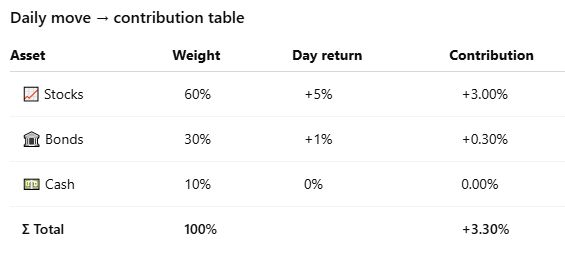
Each €100 becomes €103.30 (before fees).
Note: Ongoing fees (TER) are taken from the fund and reflected in the NAV.
Key features
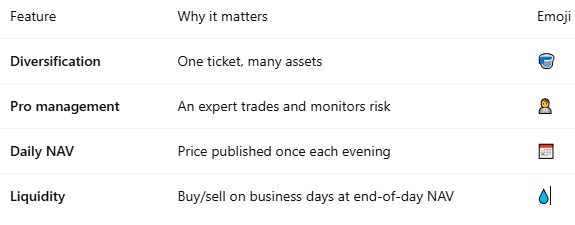
Common pitfalls
- Past performance ≠ guarantee. Strong recent returns can reverse.
- Diversification ≠ no losses. Broad markets can fall together.
- Timing & price. You trade at end‑of‑day NAV, not live intraday prices (unlike ETFs).
- Fees matter. TER and any loads/transaction costs reduce returns.
- Minimums & share classes. Check currency, distribution/accumulation, and minimum investment.
Mini‑checklist (before you buy)
- Goal & time horizon match the fund’s strategy.
- Risk level: volatility/drawdown acceptable?
- Costs: TER, entry/exit fees, platform costs.
- Size & age: AUM big enough? Track record sufficient?
- Benchmark & top holdings make sense.
Quick recap — at a glance
✅A mutual fund = crowdfunded investment basket run by a manager.
✅You hold units (not the individual securities).
✅Priced by NAV once daily; instant diversification and simple access.
Risk Warning
Important: The value of your investments may go up or down — your capital is at risk. This content is for educational purposes only and not financial advice. Copy Trading does not amount to investment advice and past performance is not indicative of future results. Investing in funds or ETFs involves market risks, including potential loss of capital. Do your own research or consult a qualified professional.
Ready to practice?
Explore mutual‑fund ETFs in a free demo account: ➡️ Open an account on eToro
See my live stats: ➡️ View my eToro profile



About the author
André Cruz — Popular Investor on eToro, managing a disciplined, risk-controlled long-term portfolio. Personal performance exceeds 800% since 26 March 2019, with CISI Level 3 and Level 4 qualifications in Wealth & Investment Management.
Follow me on eToroKnowledge check
5 questions. You need 70% to pass this lesson.
1. What is the primary definition of a mutual fund as described in the lesson?
2. When is the price (NAV) of a mutual fund calculated?
3. Which of the following is considered a common pitfall when investing in mutual funds?
4. What does the abbreviation NAV stand for in the context of mutual funds?
5. How are ongoing fees (TER) handled in a mutual fund?
Educational content only — not investment advice. Your capital is at risk.