
Fund & ETF Mastery
Lesson 2: ETFs Explained 📈💹
Fund & ETF Mastery🎓
Plain‑English definition An Exchange‑Traded Fund (ETF) is a basket of assets—like a mutual fund—but it trades on an exchange just like a single stock. You get diversification and intraday liquidity. 🚀
How does an ETF work?
- Creation/Redemption — large institutions called Authorized Participants (APs) swap baskets of stocks for new ETF shares and vice‑versa.
- Exchange trading — you buy/sell ETF units throughout the day at market price.
- Market makers keep the ETF price close to its Net Asset Value (NAV) via arbitrage.
Who are APs? Big banks or broker‑dealers (e.g., Goldman Sachs, JP Morgan) contracted to create/redeem ETF shares in blocks of ≈ 50,000 units. • If price > NAV: AP delivers the basket, receives new shares, sells them → price down. • If price < NAV: AP buys cheap shares, redeems for the basket, sells the basket → price up. This arbitrage keeps ETFs tightly priced. 🔄
Real‑life example 🔍
You buy 50 shares of SPY at $500 (total $25,000). In one trade you now hold exposure to 500+ S&P 500 stocks. If Apple climbs, SPY climbs too. You can sell five minutes later—just like trading a regular stock. 🏎️
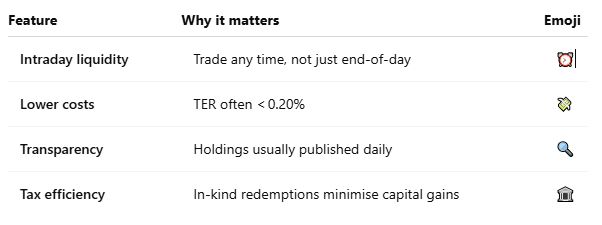
Key features
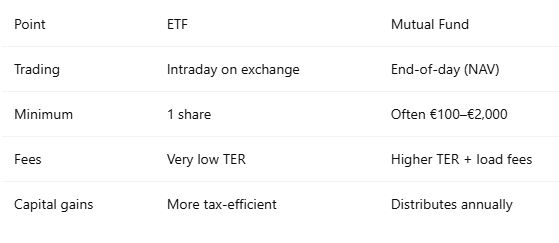
ETF vs. Mutual Fund – Quick showdown
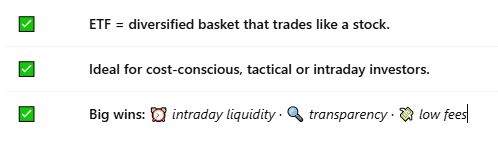
Quick recap — at a glance
Risk Warning
eToro is a multi‑asset investment platform. The value of your investments may go up or down. Your capital is at risk. This content is for educational purposes only and does not constitute financial advice.
- Copy Trading does not amount to investment advice. Past performance is not indicative of future results.
- Always do your own research or consult a qualified professional.
Ready to practice?
Explore ETF investing in a free demo account: ➡️ Open an account on eToro
See my live stats: ➡️ View my eToro profile



About the author
André Cruz — Popular Investor on eToro, managing a disciplined, risk-controlled long-term portfolio. Personal performance exceeds 800% since 26 March 2019, with CISI Level 3 and Level 4 qualifications in Wealth & Investment Management.
Follow me on eToroKnowledge check
5 questions. You need 70% to pass this lesson.
1. What is a primary characteristic of an ETF that distinguishes it from other types of funds?
2. Who are the Authorized Participants (APs) in the ETF ecosystem?
3. How do market makers keep the price of an ETF close to its Net Asset Value (NAV)?
4. What happens when an ETF's market price is higher than its Net Asset Value (NAV)?
5. What is the benefit of buying an ETF like SPY mentioned in the lesson?
Educational content only — not investment advice. Your capital is at risk.